
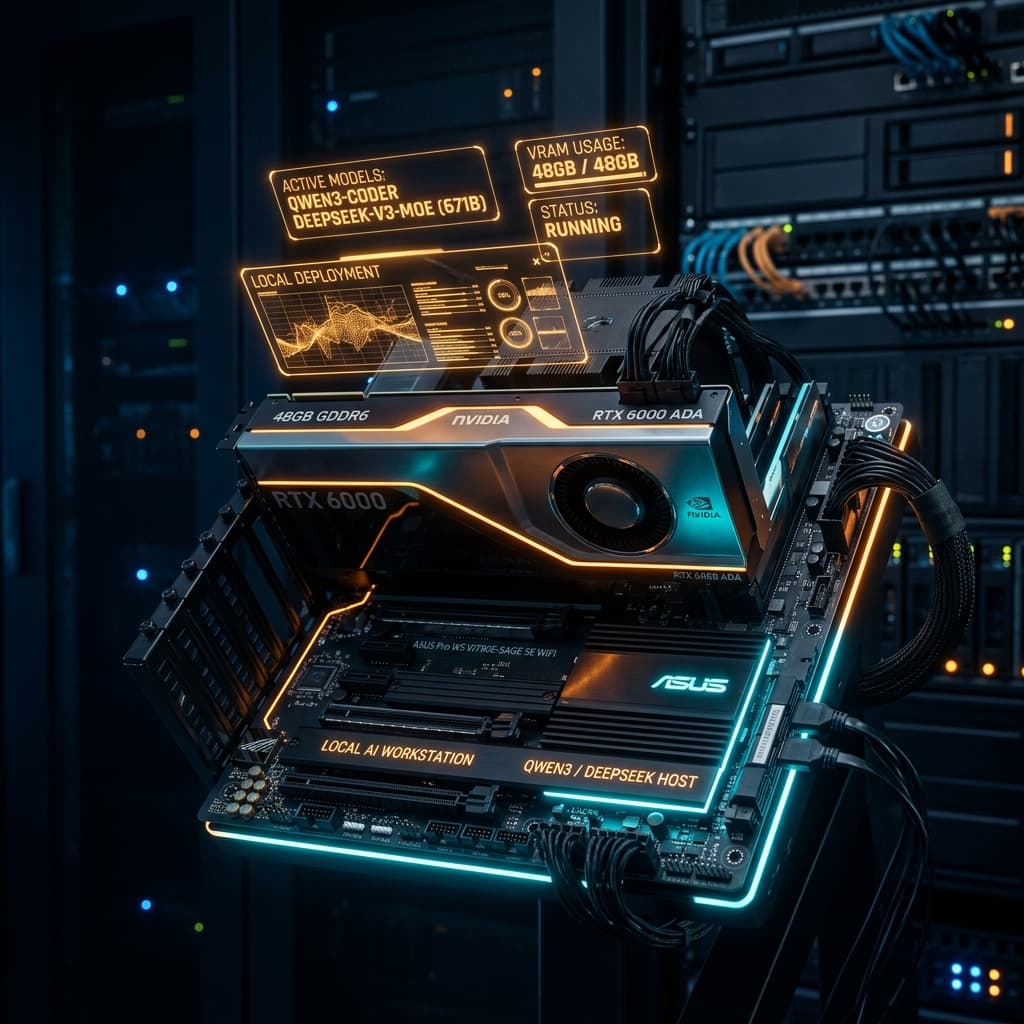
The old world was simple: you paid an API bill and someone else worried about servers. The new world is better: you own the model, the weights, and the throughput — and your data never leaves your machine. By mid-2026, the open-weight model ecosystem has reached a point where Alibaba's Qwen3-Coder series and the entire DeepSeek lineage can be run locally with performance that rivals, and in many developer workflows outright beats, proprietary cloud APIs. The catch? You need to know exactly how much VRAM you need, which Ollama tag to pull, and what hardware configuration is actually viable at each tier.
This guide cuts through the noise entirely. No vague "it depends" answers. You'll find exact Ollama pull commands, VRAM requirement tables, quantization trade-off math, and specific hardware profiles for everything from a budget developer workstation running the Qwen3-Coder-30B on a single RTX 3090, all the way up to the monstrous DeepSeek-V4-Pro requiring a petabyte-scale cluster. The Mixture-of-Experts architecture powering these models fundamentally decouples memory capacity from compute throughput — and understanding that asymmetry is the key to provisioning hardware correctly.
Quick Answer: How Much VRAM Do You Need?
VRAM requirements scale with model size and quantization. MoE models need full parameter storage in memory but only activate a fraction per token.
- Qwen3-Coder-30B (single 24GB GPU):
ollama run qwen3-coder:30b— ~19–24GB - Qwen3-Coder-Next (2×24GB or 64GB unified): Q4_K_XL tag — ~46GB
- DeepSeek-R1-Distill-70B (dual 24GB):
ollama pull deepseek-r1:70b— ~48GB - DeepSeek-V4-Flash Q4 (4×24GB): ~80GB model weights + cache overhead
- Qwen3-Coder-480B (4×80GB server):
ollama run qwen3-coder:480b— ~271GB
- 1. Why MoE Architecture Changes the VRAM Equation
- 2. Qwen3-Coder Series: Models, Tags & Hardware Profiles
- 3. DeepSeek V3, R1 & V4: Full Deployment Specifications
- 4. Quantization Tiers: The VRAM/Quality Trade-off Table
- 5. Step-by-Step Deployment: Ollama Setup & Commands
- 6. Hardware Decision Framework by Budget & Use Case
- Quick Decision Tree: Which Model for Your Hardware?
- Frequently Asked Questions
- MoE ≠ Dense Memory: A 30B MoE model activates only 3B parameters per token — but all 30B must sit in VRAM/unified memory for routing to work. Don't let the "active params" number fool you into underprovisioning.
- Qwen3-Coder-30B is the 2026 sweet spot: Fits a single 24GB GPU at default quantization, delivers 30B-class output quality at 8B-class generation speeds — the best bang-for-VRAM ratio available today.
- Qwen3-Coder-Next is not a thinking model: It's a fast, non-recursive agentic model engineered for overnight coding runs — no infinite reasoning loops, pure throughput.
- DeepSeek's distilled variants are underrated: R1-Distill-32B on a single 24GB GPU at Q4 delivers R1-grade reasoning quality at consumer hardware prices.
- V4-Flash is the local ceiling: 284B total / 13B active, feasible with 4×24GB GPUs at Q4. Beyond this, you need enterprise clusters.
VRAM estimates include a 1.2× loading overhead buffer. Context cache overhead is not included unless noted. Data synthesized from Unsloth GGUF release notes and official model cards, May 2026.
developer_boardFind Your Perfect Local LLM Hardware Config
Not sure which GPU or unified memory setup matches your target model? Use our interactive hardware finder to calculate exact VRAM needs for any model size and quantization.
Launch Hardware Finder Tool → Updated May 2026. Covers Qwen3-Coder, DeepSeek V3/R1/V4, Llama 3.x and more.Quick take: Memory capacity is the hard wall. Memory bandwidth is the speed limit. And quantization is your lever between the two. Get the capacity right first — if parameters don't fit in your fastest memory tier, generation speed collapses by 10–30× the moment you hit the PCIe offload cliff.
1. Why MoE Architecture Changes the VRAM Equation
Before diving into specific models and commands, understanding the fundamental memory dynamics of Mixture-of-Experts (MoE) architecture is non-negotiable. Every flagship model in this guide — Qwen3-Coder-30B, Qwen3-Coder-Next, Qwen3-Coder-480B, DeepSeek V3, R1, and V4 — uses MoE. And MoE creates a counterintuitive hardware provisioning challenge that catches first-time deployers by surprise.
In a standard dense transformer model, the relationship between model size and VRAM requirements is linear and obvious: a 7B parameter model at FP16 needs ~14GB. But in an MoE model, the architecture splits the feed-forward network into many parallel "expert" sub-networks, then routes each input token to only a small subset of experts via a learned gating function. Qwen3-Coder-30B-A3B, for example, has 30 billion total parameters organized across 128 experts, but routes each token to only 8 active experts — resulting in only 3.3 billion active parameters per forward pass.
The critical implication: all 30 billion parameters must reside in accessible high-speed memory. The routing algorithm can call any expert at any time based on the input token. If even a fraction of those expert weights are offloaded to slower PCIe-connected system RAM, every token generation event that routes to an offloaded expert triggers a catastrophic latency spike — reducing a 30+ tokens/sec model to 2–4 tokens/sec in the worst case.
Parameter counts from official Qwen3-Coder and DeepSeek V4 model cards. Active parameter ratios vary by architecture.
The Memory-Bandwidth Asymmetry
MoE also creates a profound memory bandwidth dependency during the decode phase (text generation). Because the entire parameter space must remain hot in memory — and any of those experts may be called for any token — the system must continuously stream weight tensors from memory to compute cores. This means MoE models are even more memory-bandwidth-constrained than equivalent dense models of the same active parameter count.
The result: a 30B MoE model generates text at roughly the speed of an 8B dense model (due to only 3B active params per step), but it requires the VRAM footprint of a 30B model. This is the MoE bargain — and it's a genuinely good deal if you provision hardware correctly. The practical implication is that GPU or unified memory capacity takes absolute priority over raw compute (TOPS or TFLOPS) when selecting hardware for these models.
Use total parameters (not active parameters) for the base calculation. The 1.2× safety multiplier accounts for temporary spikes during model loading. KV cache scales with context window length — a 128K context on a 30B model adds roughly 8–12GB of additional pressure.
Context Window & KV Cache: DeepSeek's MLA Advantage
DeepSeek's V2, V3, R1, and V4 architectures introduced Multi-Head Latent Attention (MLA) — a mechanism that compresses Key-Value tensors into a lower-dimensional latent space before caching them, then projects them back to full dimensions only at inference time. This compression reduces KV cache memory requirements by approximately 12× compared to Grouped-Query Attention and up to 64× compared to standard MHA. The practical result: DeepSeek-V4-Flash can maintain a 1,000,000-token context window with only ~10GB of cache overhead — a feature previously requiring petabyte-scale data center resources.
Qwen3-Coder-Next takes a different approach: it interleaves Gated DeltaNets (linear attention / state-space mechanics) with traditional Gated Attention layers in a 3:1 ratio, enabling linear-time context scaling. This hybrid layout — 12 blocks of (3 × DeltaNet-MoE → 1 × Attention-MoE) — supports 262,144 native tokens with dramatically lower memory scaling compared to pure transformer attention.
2. Qwen3-Coder Series: Models, Tags & Hardware Profiles
Alibaba's Qwen3-Coder series is the definitive local-first coding model ecosystem as of mid-2026. Built specifically for autonomous software engineering, executable task synthesis, IDE integration, and long-horizon agentic workflows, the series spans an enormous range — from edge-device 0.6B models to the flagship 480B behemoth. For local deployment purposes, three variants dominate the conversation.
Qwen3-Coder-30B-A3B: The Developer Workstation King
The 30B variant is where local LLM deployment becomes genuinely practical for individual developers. With 30 billion total parameters activating only 3.3 billion per token across 128 experts (8 active), it delivers output quality comparable to 30B-class dense models at the inference speed of a much smaller model. A single high-end consumer GPU handles it comfortably at default quantization.

ASUS TUF RTX 4090 24GB — Best Single GPU for Qwen3-Coder-30B
From $3,500
The 24GB Sweet Spot: Comfortably runs Qwen3-Coder-30B fully in VRAM at default Q4 quantization, plus DeepSeek R1-Distill-32B. 24GB GDDR6X gives you the buffer to push 64K context windows without hitting the PCIe offload cliff.
View Deal →Qwen3-Coder-Next (80B Total / 3B Active): The Agentic Powerhouse
Qwen3-Coder-Next occupies a unique architectural space. At 80 billion total parameters with only ~3 billion active parameters, it delivers near-frontier coding quality while maintaining the generation speed of an 8B model. Its hybrid DeltaNet-Attention architecture natively supports 262,144-token contexts — critical for agentic workflows spanning entire codebases.
Critical architectural note: Qwen3-Coder-Next is explicitly compiled as a non-thinking model. Unlike other Qwen3 variants that can enter deep multi-step reasoning loops, Next skips internal evaluation blocks entirely in favor of rapid, reflexive agentic responses. This is intentional and essential for overnight autonomous coding runs — earlier thinking-mode models would frequently enter infinite verification loops on complex tasks, causing automated workflows to stall. Next bypasses this entirely.

MacBook Pro 16" (M4 Max, 128GB) — Top Pick for Qwen3-Coder-Next
From $4,100
Unified Memory Powerhouse: 128GB of unified memory at 546 GB/s bandwidth — runs Qwen3-Coder-Next Q4_K_XL (~46GB) with massive context headroom, silently, on battery. The best portable deployment for Next that money can buy.
View Deal →Qwen3-Coder-480B-A35B: The Frontier Local Model
The flagship 480B model with 35 billion active parameters is the most capable locally-deployable coding model in existence as of May 2026. Its 262,144-token native context can be extended to 1 million tokens via YaRN (Yet another RoPE extensioN method). It supports over 100 programming languages and achieves benchmark scores rivaling closed-source frontier models on coding tasks. The hardware bar is high: you're looking at 4× 80GB enterprise accelerators at minimum.
Qwen3-Coder Ollama Tags & Hardware Profiles
| Model Variant | Ollama Tag / Command | Total Memory Required | Recommended Hardware | Max Context |
|---|---|---|---|---|
| Qwen3-Coder-30B | ollama run qwen3-coder:30b |
~19–24 GB | 1× 24GB GPU (RTX 4090 / RTX 3090) | 64K |
| Qwen3-Coder-Next (BF16) | hf.co/unsloth/Qwen3-Coder-Next-GGUF:BF16 |
~159 GB | 2× 80GB Server Accelerators (H100/A100) | Full 256K |
| Qwen3-Coder-Next (Q8_0) | hf.co/unsloth/Qwen3-Coder-Next-GGUF:Q8_0 |
~85 GB | 4× 24GB GPUs / 128GB Unified Memory | Full 256K |
| Qwen3-Coder-Next (Q4_K_XL) | hf.co/unsloth/Qwen3-Coder-Next-GGUF:UD-Q4_K_XL |
~46 GB | 2× 24GB GPUs / 64GB Unified Memory | Up to 120K |
| Qwen3-Coder-480B (default Q4) | ollama run qwen3-coder:480b |
~271 GB | 4× 80GB Server / 512GB Unified Memory | 128K |
| Qwen3-Coder-480B (Q2_K) | ollama run qwen3-coder:480b-q2_k |
~163 GB | 2× 80GB Server / 192GB Unified Memory | 64K |
Data synthesized from Unsloth GGUF release notes and official Qwen3-Coder model cards, May 2026. Memory estimates include ~1.2× loading overhead buffer.
--n-gpu-layers flag, this hybrid approach can achieve ~180 tokens/sec for prompt ingestion and ~30 tokens/sec for generation — usable for real-time IDE integration.

ASUS ROG Flow Z13 (Ryzen AI Max 395) — Best x86 UMA for MoE Models
From $2,707
Strix Halo MoE Beast: AMD Ryzen AI Max 395 with up to 128GB unified LPDDR5X RAM at 256 GB/s. Runs Qwen3-Coder-Next Q4_K_XL at ~98 tokens/sec thanks to the MoE architecture's low active-parameter bandwidth. The best x86 local LLM machine for the money.
View Deal →3. DeepSeek V3, R1 & V4: Full Deployment Specifications
While Qwen3-Coder dominates the coding-specific niche, DeepSeek's model lineage serves as the foundational general-purpose logic architecture for local deployment in 2026. The ecosystem spans three distinct generations, each with different hardware requirements and use-case profiles.
DeepSeek V3 & R1: The 671B Workhorses
DeepSeek V3 (foundation model) and R1 (advanced reasoning variant) share an identical architectural footprint: 671 billion total parameters, 37 billion active parameters, 256 routed experts plus one shared expert. R1 is fine-tuned specifically for complex logical reasoning using reinforcement learning on chain-of-thought traces, making it the superior choice for mathematics, structured analysis, and multi-step problem solving. V3 excels at general instruction following and code generation.
At Q8_0 precision, the R1 model consumes approximately 700GB — firmly datacenter territory. At Q4_K_M, the requirement drops to ~400GB, feasible only on specialized multi-accelerator workstations or maximum-capacity unified memory systems (Mac Studio Ultra with 512GB). The distilled variants (covered below) are the pragmatic path for most independent developers.
DeepSeek V4-Pro & V4-Flash: Million-Token Intelligence
Released in April 2026, the V4 ecosystem introduces DeepSeek's hybrid Compressed Sparse Attention + Heavily Compressed Attention mechanism — the technology that enables a 1,000,000-token context window with only ~10GB of KV cache overhead locally. Two models comprise the V4 lineup:
- DeepSeek-V4-Pro: 1.6 trillion total parameters, 49 billion active parameters. Requires enterprise cluster topologies with high-bandwidth interconnects (NVLink or InfiniBand). Not practical for individual local deployment at any consumer hardware tier.
- DeepSeek-V4-Flash: 284 billion total parameters, 13 billion active parameters. Achieves approximately 95% of the Pro variant's benchmark performance. This is the practical ceiling for high-end local self-hosting and the most capable model a well-resourced individual can realistically deploy.
DeepSeek-V4-Flash: VRAM Requirements by Quantization Tier
| Quantization Tier | Est. Weight Size | Minimum VRAM | Safe VRAM (with context) | Target Hardware |
|---|---|---|---|---|
| FP4+FP8 Mixed (official) | ~159.6 GB | 170 GB | 192–256 GB | 4× 80GB (H100) or 2× 141GB (MI300X) |
| Q6 Precision | ~120.0 GB | 130 GB | 160–192 GB | 2× 80GB Server Hardware |
| Q4 Standard | ~80.0 GB | 96 GB | 128 GB | 4× 24GB GPUs / 192GB Unified |
| Q2 Experimental | ~40.0 GB | 48 GB | 64 GB | 2× 24GB GPUs / 64GB Unified |
Q2 quantization results in ~15–25% degradation in reasoning quality — acceptable for summarization or general queries, not recommended for complex coding or math. Recommend Q4 as minimum for production use.
Hardware topology note: Continuous batching engines prefer power-of-two hardware configurations for optimal tensor parallelism. Two 80GB accelerators (160GB total) falls just short for a full million-token context with V4-Flash. A quad-accelerator setup providing 320GB is the strongly recommended deployment standard to absorb both weights and cache without OOM errors.
DeepSeek Distilled Models: R1 Intelligence on Consumer Hardware
Recognizing the hardware barriers of the 671B and 1.6T architectures, DeepSeek released a suite of distilled models — dense transformers (built on Llama and Qwen bases) trained on the logical verification traces generated by the flagship R1. These bypass MoE routing complexity entirely while preserving R1-grade reasoning capability in significantly smaller footprints.
| Distilled Model | Base Architecture | Ollama Tag | VRAM (Q4) | Target Hardware |
|---|---|---|---|---|
| R1-Distill-1.5B | Qwen | ollama pull deepseek-r1:1.5b |
~2 GB | Any laptop, embedded devices |
| R1-Distill-8B | Llama 3 | ollama pull deepseek-r1:8b |
~6 GB | 8GB unified memory, mainstream GPUs |
| R1-Distill-14B | Qwen | ollama pull deepseek-r1:14b |
~10 GB | 16GB GPUs, M-series Pro |
| R1-Distill-32B | Qwen | ollama pull deepseek-r1:32b |
~24 GB | Single 24GB GPU, 64GB unified |
| R1-Distill-70B | Llama 3 | ollama pull deepseek-r1:70b |
~48 GB | Dual 24GB GPUs, 128GB unified |
Data from DeepSeek model cards and community benchmarks. Q4_K_M quantization used as baseline.
ASUS TUF RTX 4090 24GB — R1-Distill-32B Single GPU Pick
From $3,500
R1 Reasoning at Consumer Price: R1-Distill-32B fits exactly in 24GB at Q4 with ~35 tok/s. Also handles Qwen3-Coder-30B simultaneously as the main coder, making this GPU the foundation of the ideal dual-model local dev setup.
View Deal →
Gigabyte RTX 4070 Ti Super 16GB — Budget Pick for R1-Distill-14B
From $999
Mid-Range Reasoning Power: 16GB GDDR6X VRAM handles DeepSeek R1-Distill-14B fully in VRAM at ~45 tok/s. The 256-bit bus also allows hybrid R1-Distill-32B execution with system RAM offloading — a practical ~15 tok/s setup on a tight budget.
View Deal →4. Quantization Tiers: The VRAM/Quality Trade-off Table
Quantization is the primary lever between "this won't fit" and "this runs." The 2026 landscape features a mature set of formats with well-understood trade-off profiles. Choosing the wrong tier — either over-quantizing and sacrificing code quality, or under-quantizing and running out of VRAM — is the most common deployment mistake.
| Format | Bytes / Param | VRAM vs. FP16 | Quality Loss | Best Use Case |
|---|---|---|---|---|
| BF16 / FP16 (full) | 2.0 | Baseline | None | Server-class deployments, research |
| Q8_0 | 1.0 | −50% | ~1–2% | Best quality/VRAM balance for code |
| Q6_K | 0.75 | −62% | ~2% | High-quality production with memory savings |
| Q5_K_M | 0.70 | −65% | ~2–3% | Good code quality, moderate VRAM savings |
| Q4_K_M (industry standard) | 0.55 | −72% | ~3–5% | 2026 sweet spot — most local deployments |
| Q4_K_XL (Unsloth UD) | ~0.58 | ~−70% | ~3–4% | Qwen3-Coder-Next optimized variant |
| Q2_K | 0.25 | −87% | 15–25% | Experimental only — avoid for coding tasks |
Quality loss estimates based on perplexity degradation benchmarks and HumanEval coding pass rate comparisons. Coding tasks are more sensitive to quantization artifacts than general text generation.
The NexaQuant Breakthrough for Distilled Models
A significant 2026 advancement for deploying the smaller R1 distilled models is the NexaQuant algorithm. Traditional Q4_K_M quantization of an 8B model resulted in ~22% accuracy degradation on complex reasoning benchmarks. NexaQuant targets specific layer weight distributions, achieving a 4× size reduction while maintaining near-perfect parity with the FP16 baseline. On HellaSwag and MMLU benchmarks, NexaQuant 4-bit deployments score within 1 percentage point of the unquantized model — ensuring the distilled R1 reasoning capability remains intact even at minimum VRAM.
5. Step-by-Step Deployment: Ollama Setup & Commands
The fastest path to running Qwen3-Coder or DeepSeek locally is through Ollama — it handles GGUF format management, GPU detection, automatic layer offloading, and the API server in a single binary. Here's the complete setup sequence from zero to running inference in under 10 minutes.
-
Install Ollama (Linux/Mac/Windows):
curl -fsSL https://ollama.com/install.sh | sh # Windows: Download installer from https://ollama.com/download
-
Pull and run Qwen3-Coder-30B (the 24GB GPU build):
ollama run qwen3-coder:30b # Ollama auto-detects GPU and optimizes layer allocation
-
Pull Qwen3-Coder-Next at Q4_K_XL (2×24GB or 64GB unified):
ollama run hf.co/unsloth/Qwen3-Coder-Next-GGUF:UD-Q4_K_XL
-
Pull DeepSeek R1 distilled variants:
# For single 24GB GPU (R1 reasoning in 24GB): ollama pull deepseek-r1:32b # For dual 24GB GPUs (full 70B quality): ollama pull deepseek-r1:70b # Budget option - any laptop with 8GB RAM: ollama pull deepseek-r1:8b
-
Enable KV Cache compression for long-context models:
# Compress KV cache to Q8 — critical for 128K+ context windows export OLLAMA_KV_CACHE_TYPE=q8_0 # Then run your model as normal ollama run qwen3-coder:30b
Setting KV_CACHE_TYPE=q8_0 reduces KV cache memory by ~50% with negligible quality loss on context recall tasks.
-
Advanced — llama.cpp with explicit GPU layer control:
# Load specific number of layers onto GPU (tune based on your VRAM): llama-server --model qwen3-coder-30b.Q4_K_M.gguf \ -c 65536 \ --n-gpu-layers 60 \ --host 0.0.0.0 --port 8080
-
Connect to local model from IDE (Continue.dev / Cursor):
In Continue.dev
config.json, set your model provider toollamaand point tohttp://localhost:11434. Selectqwen3-coder:30bas the model ID. Cursor supports Ollama through the custom model endpoint feature in Settings → Models → Add Model.
--num-ctx 16384 to keep KV cache manageable, then increase to 32768 or 65536 once you've validated stable inference. Larger context windows eat into your generation speed headroom proportionally.
6. Hardware Decision Framework by Budget & Use Case
The right hardware tier depends entirely on which models you need to run and at what context length. Here is the definitive 2026 tier breakdown, ordered from most accessible to most capable.
Tier 1: Budget Developer (~$500–$1,500 hardware)
A system with a single RTX 4090 (24GB) or equivalent 24GB VRAM GPU, paired with 64GB of DDR5 system RAM. This setup supports the full Qwen3-Coder-30B at default quantization (the 2026 sweet spot for local coding) and all DeepSeek R1 distilled models up to 32B. With hybrid CPU+GPU offloading via llama.cpp, you can even push Qwen3-Coder-Next Q4_K_XL (~46GB) by storing the overflow expert layers in fast system RAM, trading ~50% of generation speed for access to the full 80B model quality.
- Primary model:
ollama run qwen3-coder:30b(runs fully in VRAM) - Reasoning model:
ollama pull deepseek-r1:32b(fits in 24GB at Q4) - Generation speed: ~35–55 tokens/sec on Qwen3-30B
- Context limit: ~64K practical (VRAM constrained at longer contexts)
MSI Titan 18 HX (RTX 5090 Mobile) — Best Mobile GPU for Qwen3-30B
From $3,499
Fastest Mobile Inference: The RTX 5090 Mobile (32GB GDDR7) pairs Blackwell-class memory bandwidth with a portable chassis. Runs Qwen3-Coder-30B and DeepSeek R1-Distill-32B simultaneously, with headroom left for extended context windows — the best GPU laptop for local LLM inference in 2026.
View Deal →Tier 2: Serious Developer (~$3,000–$8,000 hardware)
Two RTX 4090s (48GB combined) or equivalent dual-GPU setup, or a unified memory system like the Mac Studio M3 Ultra / M4 Ultra with 128–192GB. This unlocks Qwen3-Coder-Next at Q8_0 quality, DeepSeek R1-Distill-70B fully in fast memory, and partial DeepSeek V3/R1 671B access at aggressive quantization.
- Primary model: Qwen3-Coder-Next Q8_0 (~85GB — fits in 128GB unified memory)
- Reasoning model: DeepSeek R1-Distill-70B fully in fast memory
- Context limit: Full 256K for Next with appropriate KV cache compression
MacBook Pro 16" (M4 Max, 128GB) — Top Tier 2 Pick
From $4,100
Silent 128GB Unified Memory: The M4 Max delivers 546 GB/s of unified bandwidth across 128GB, running Qwen3-Coder-Next Q8_0 (~85GB) with 43GB left for full 256K context cache. Zero fan noise, 14+ hour battery — the definitive Tier 2 portable AI workstation.
View Deal →Tier 3: Enterprise Enthusiast (~$15,000–$40,000 hardware)
4× RTX 4090 (96GB) or 2× enterprise 80GB accelerators (160GB), or a Mac Studio Ultra 512GB. This tier unlocks DeepSeek-V4-Flash at Q4 quantization (~80GB weights, with context overhead requiring the full 96GB+ buffer), and Qwen3-Coder-480B at aggressive Q2_K quantization (~163GB in dual 80GB configs).
Tier 4: Server / Research Lab (>$50,000)
4–8× enterprise 80GB accelerators (320–640GB VRAM) or 512GB+ unified memory systems. Enables DeepSeek-V4-Flash at full mixed-precision FP4+FP8 (~175GB) with complete 1M-token context, and Qwen3-Coder-480B at Q4 or Q5 quality. The V4-Pro (1.6T parameters) remains cluster-only territory.
Known Limitations (May 2026): Qwen3-Coder-Next GGUF quantization for the UD-Q4_K_XL tag is maintained by the Unsloth community — not Alibaba officially. Check the Unsloth HuggingFace page for the latest quantization updates as the model's official GGUF support matures. DeepSeek V4-Flash community GGUF support is in active development; official vLLM deployment via FP8 remains the most stable path for the full mixed-precision weights.
Quick decision tree: Which model for your hardware?
- Single 24GB GPU (RTX 4090/3090): → Qwen3-Coder-30B (primary coding) + DeepSeek R1-Distill-32B (reasoning). Best local setup under $1,500 in GPU cost.
- 16GB GPU (RTX 4080/5080) + fast system RAM: → DeepSeek R1-Distill-14B fully in VRAM, or Qwen3-Coder-30B with some layer offloading. Generation speed drops ~30% vs 24GB GPU.
- 8GB GPU or integrated (mainstream laptops): → DeepSeek R1-Distill-8B or Qwen3-Coder-7B/8B. Fast, capable for light tasks; not suitable for large codebase work.
- Mac with 64–96GB Unified Memory (M3/M4 Pro/Max): → Qwen3-Coder-Next Q4_K_XL (~46GB) or DeepSeek R1-Distill-70B. Best mobile local LLM setup available.
- Mac with 128–192GB Unified Memory (M3/M4 Ultra): → Qwen3-Coder-Next Q8_0 (~85GB) or DeepSeek V4-Flash Q2. Silent, efficient, no VRAM constraints up to this tier.
- Multi-GPU workstation (4× 24GB): → DeepSeek V4-Flash Q4 (~96GB) or Qwen3-Coder-480B Q2_K (~163GB). Enters server-class model territory.
- Dual enterprise 80GB (160GB): → DeepSeek V4-Flash Q6 (~120–130GB) with 256K context. The highest single-developer local deployment tier.