
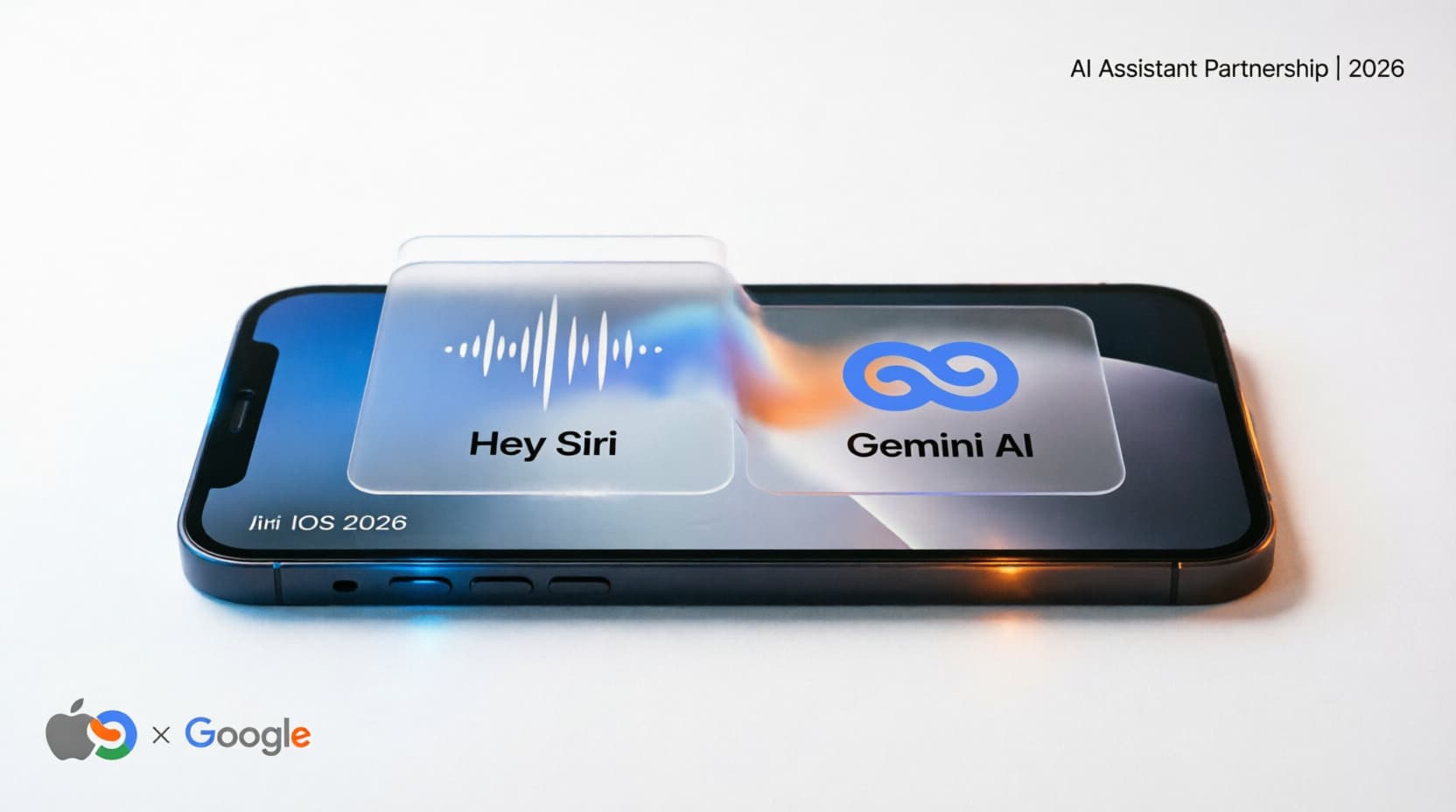
On January 12, 2026, Apple and Google made an announcement that nobody saw coming: Siri - the AI assistant that has been the butt of jokes for years - is getting a complete rebuild powered by Google Gemini. The two biggest rivals in the phone business are now AI partners. If you use an iPhone for studying, work, or anything else, this changes things. Here is everything that is actually confirmed, what is still unclear, and what it means for you right now.
Quick verdict: The new Gemini-powered Siri is a genuine upgrade - smarter, context-aware, and capable of multi-step tasks your current Siri cannot handle. But the most exciting features are not shipping yet. The first wave arrives with iOS 26.5 (April–May 2026). The full rebuild comes with iOS 27 in September 2026. You do not need to do anything right now - it updates automatically.
What Apple and Google Actually Announced
The official joint statement from Apple and Google on January 12, 2026 was precise about what is happening: "Apple and Google have entered into a multi-year collaboration under which the next generation of Apple Foundation Models will be based on Google's Gemini models and cloud technology. These models will help power future Apple Intelligence features, including a more personalized Siri coming this year."
This is not Apple replacing Siri with Google Assistant. Gemini is running as the AI engine underneath - what engineers call a "white-label" arrangement. You will never see Google branding anywhere. You will still see and interact with Siri. The voice, the interface, the Apple design - all unchanged. What changes is the intelligence underneath it.
Apple also confirmed that Apple Intelligence will continue to run on Apple devices and the company's Private Cloud Compute infrastructure - meaning your data does not go to Google's servers. This is the key privacy distinction Apple is making.
Why Apple Did This - The Real Story
Apple has been struggling to build competitive AI models in-house for years. When Apple Intelligence launched with iOS 18 in 2024, it used a compact on-device model of around 3 billion parameters - capable enough for basic tasks like summarising notifications and rewriting text, but nowhere near the intelligence of ChatGPT or Gemini.
The "more personalized Siri" - the version that could understand your personal context, take actions across apps, and have real conversations - was supposed to ship with iOS 18. Apple delayed it. Then delayed it again on March 7, 2025. By the time iOS 26 shipped, it still had not arrived. Two years of promises.
Rather than wait another year for its own models to catch up, Apple made a pragmatic decision: license the best model available and use it as the foundation for Apple Foundation Models going forward.
Apple also explored two other options before landing on Google. Talks with Anthropic stalled around August 2025 - Anthropic reportedly asked for several billion dollars annually over multiple years. A deal with OpenAI was also unfavourable: OpenAI was actively competing with Apple in hardware through its partnership with Jony Ive.
Google made sense for three additional reasons. Apple already had an existing multi-billion dollar deal with Google for default search. A court ruling in September 2025 cleared the search monopoly concerns that could have complicated further Google-Apple deals. And Google surpassed Apple in market capitalisation for the first time since 2019 - a signal of how much Google's AI momentum had grown.
What the New Siri Can Actually Do
Based on confirmed reports from Bloomberg, MacRumors, and 9to5Mac, here is what the Gemini-powered Siri will be capable of:
Personal context awareness
The new Siri understands your personal context across apps. Apple demonstrated an example where a user asks Siri about their mother's flight and lunch reservation plans - Siri pulls this from Mail and Messages automatically without you having to specify where to look. This is a fundamental shift from the current Siri which operates app-by-app.
On-screen awareness
The new Siri can read and reference content currently displayed on your iPhone screen in real time. Browse a restaurant in Safari and ask Siri to book a table - it already knows which restaurant you are looking at. This is the feature Apple previewed at WWDC 2024 but never shipped.
Multi-step task execution
The new Siri can decompose a complex request into subtasks and execute them across multiple apps. "Move my 3pm meeting, tell the other person I'll be late, and order me a coffee for when I arrive" - that kind of chain of actions across Calendar, Messages, and a delivery app.
Complex reasoning
Because Gemini's reasoning capabilities power the foundation, the new Siri handles ambiguous questions, follows up with clarifying questions, and maintains context across a longer conversation - not just single-shot commands.
Deeper per-app controls
Third-party app developers will be able to expose their app's capabilities to Siri so it can take actions inside them. This has been promised for years - the Gemini foundation is what makes it technically feasible at scale.
The Bigger Picture - iOS 27 and Multiple AI Models
The first wave of Gemini-powered features in iOS 26.5 is just the beginning. iOS 27, expected to be previewed at WWDC on June 8, 2026 and ship in September, is where the full vision arrives.
According to Bloomberg's Mark Gurman, iOS 27 will introduce something unprecedented: a choice of AI models. Users will be able to select their preferred AI - ChatGPT, Claude, Gemini, or others - as their primary conversational engine within Siri. The process involves downloading the relevant app and setting it in Apple Intelligence and Siri settings.
Gemini will still power the underlying Apple Foundation Models regardless of which conversational AI you pick. Think of it as two layers: Gemini as the foundation for Apple's intelligence features, and a user-selectable chatbot for conversational queries.
The Timeline - When Does Each Feature Ship?
| Release | When | What Ships |
|---|---|---|
| iOS 26.4 | March–April 2026 | First developer betas with initial Gemini-powered features. Limited rollout. |
| iOS 26.5 | April–May 2026 | First public Gemini features - personal context awareness, on-screen awareness, multi-step tasks. This is what most users will experience first. |
| WWDC 2026 | June 8, 2026 | Full reveal of iOS 27 AI features including multi-chatbot choice. Developer preview. |
| iOS 27 | September 2026 | Complete Gemini-powered Siri rebuild. User-selectable AI models (Claude, ChatGPT, Gemini). Full Apple Foundation Models v11. |
Privacy - What Actually Happens to Your Data
This is the question every iPhone user should ask. The answer is more reassuring than you might expect - but it requires understanding the architecture.
Apple has full access to the Gemini model running in Apple's own data centres - separate from Google's infrastructure. Apple uses this access to build distilled versions of Gemini that run either on-device or on Apple's Private Cloud Compute servers. Your queries go to Apple's infrastructure, not Google's. Google does not see your data.
The privacy chain: your iPhone → Apple's Private Cloud Compute → Apple's distilled Gemini models → response back to your iPhone. Google's servers are not in that chain for standard queries.
What This Means for Students Specifically
If you use your iPhone for studying, here is what the new Siri means in practical terms:
- Better homework help: The current Siri cannot reason through a problem. The Gemini-powered version can follow multi-step reasoning - explain a concept, give an example, check if you understood it, all in one conversation.
- Cross-app awareness: Siri will understand your calendar, notes, reminders, and emails together. "What do I have due this week?" becomes a genuinely useful question rather than a single-app lookup.
- Choice of AI model: By iOS 27 you can use Claude or ChatGPT through Siri rather than switching apps. If you have a Claude Pro subscription for studying, you will be able to access it directly from Siri.
- On-screen reading: Reading a complex article in Safari and want to ask about it? The new Siri sees your screen - no copy-pasting required.
- It's free: All of this is included with your existing iPhone at no extra cost. Unlike ChatGPT Plus ($20/month) or Claude Pro ($25/month), the Gemini-powered Siri features are part of iOS.
Should You Switch to Android for Google Gemini?
No. The Gemini experience on Android and the Gemini-powered Siri are different products. Android gets Gemini as a standalone assistant with Google's full ecosystem. iPhone gets Gemini's intelligence embedded into Apple's privacy-first architecture with Apple's design.
If you are a student or professional deeply embedded in the Apple ecosystem - iMessage, FaceTime, AirDrop, iCloud, Apple Notes - switching to Android to get Gemini makes no sense when Gemini is coming to Siri anyway. The better question is whether to wait for iOS 26.5 or start using Claude or ChatGPT on your iPhone right now through their native apps.
Recommended Laptops for Local AI & Security Testing
If you're interested in running AI models locally—whether for research, security testing, or simply privacy—the right hardware makes all the difference. Here are my top laptop picks for 2026, tested with models ranging from 7B to 70B parameters.

MacBook Pro M4 Max (128GB) — Ultimate AI Workstation
From $4,799
128GB unified memory lets you run 70B+ models with full context. The M4 Max's Neural Engine accelerates inference, and with TurboQuant, you can even push 100B+ models. Ideal for researchers and security professionals who need to analyze large models offline.
View on Amazon →
ASUS ROG Zephyrus G16 (RTX 5090, 64GB RAM) — Best Windows AI Laptop
From $3,499
24GB VRAM + 64GB RAM, plus a powerful Intel Core Ultra 9. Runs 13B–34B models smoothly and can even fine‑tune 7B models locally. Excellent cooling for sustained workloads, making it a great choice for red‑teaming and security research.
View on Amazon →
Lenovo ThinkBook 16 Gen 8 — Best Budget AI Laptop
From $1,199
RTX 4060 (8GB VRAM) and 32GB RAM – perfect for 7B models and small‑scale fine‑tuning. A great entry point for students and hobbyists who want to experiment with local AI without breaking the bank.
View on Amazon →