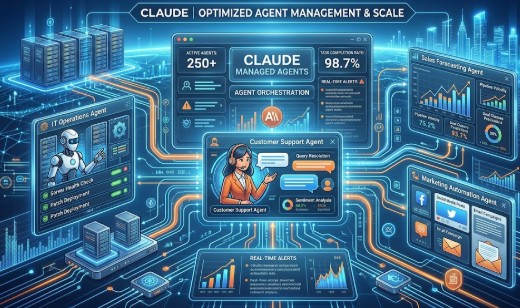
Anthropic just made its biggest enterprise move yet. On April 8, 2026, the company launched Claude Managed Agents in public beta — a cloud-hosted service that lets developers and companies build and deploy AI agents without any of the painful infrastructure work that's been slowing everyone down.
If you've been following the AI agent space, you know the frustration. Building an agent that actually works in demo takes a weekend. Getting it to run reliably in production takes months. You need to provision sandboxes, handle authentication, manage state across long sessions, set up monitoring, and deal with failure recovery — before you've written a single line of business logic. Claude Managed Agents is Anthropic's answer to that problem.
This article breaks down exactly what it is, how it works under the hood, what it costs, who's already using it, and whether it's right for your use case.
- What Is Claude Managed Agents?
- How It Works: Sessions, Harnesses & Sandboxes
- Key Features Breakdown
- Pricing: What Does It Actually Cost?
- Real-World Adopters: Notion, Asana, Sentry
- Claude Managed Agents vs Azure vs Vertex AI
- Drawbacks & Limitations
- Who Should Use It?
- Getting Started
- Frequently Asked Questions
- What: Cloud-hosted infrastructure for building and running Claude-powered AI agents
- Launched: Public beta, April 8, 2026
- Cost: $0.08/agent runtime hour + Claude model usage fees
- Handles: Sandboxing, authentication, state, scaling, monitoring — all abstracted away
- Best for: Developers and enterprise teams who want production-grade agents without DevOps overhead
- Early users: Notion, Rakuten, Asana, Sentry
- Caveat: Multi-agent, memory, and outcomes features still in research preview (waitlist)
What Is Claude Managed Agents?
Claude Managed Agents is a suite of composable APIs on the Claude Platform that lets you deploy long-running, production-grade AI agents backed by Claude models — without managing the underlying infrastructure yourself.
Think of it this way: until now, Anthropic sold you the engine (Claude models via API). You had to build the car yourself — the chassis, the brakes, the safety systems. Claude Managed Agents is Anthropic handing you a fully assembled vehicle. You still drive it, you still decide where it goes, but the mechanical complexity is handled.
Why does this matter? Over 70% of companies experimenting with AI agents cite deployment complexity — not model performance — as their biggest barrier. Claude Managed Agents is a direct attack on that problem.
The service supports both simple single-task flows (run this agent, return the result) and complex multi-agent pipelines (multiple Claude agents collaborating on subtasks, passing results between each other). Developers define what the agent should do; Anthropic's infrastructure handles tool orchestration, context management, and error recovery.
How It Works: Sessions, Harnesses & Sandboxes
Anthropic's engineering team published a detailed post explaining the design philosophy behind Managed Agents, and it's worth understanding — because the architecture is genuinely clever.
The core problem: harnesses go stale
When you build an AI agent, you write a "harness" — the scaffolding code that calls Claude, routes its outputs, handles tool calls, and manages the loop. The problem is that harnesses encode assumptions about what Claude can and can't do. As Claude improves, those assumptions get stale.
For example, earlier Claude versions would sometimes wrap up tasks prematurely when sensing the context limit approaching — a behavior called "context anxiety." Teams built workarounds into their harnesses. Then newer Claude versions fixed the behavior on their own, making the workarounds unnecessary or even counterproductive.
Claude Managed Agents solves this by acting as a meta-harness: a layer of stable interfaces that sits above any specific harness implementation, so the interfaces outlast whatever the harness looks like underneath. Anthropic drew an explicit analogy to operating systems — the read() command works regardless of whether you're accessing a 1970s disk pack or a modern SSD, because the abstraction stayed stable while the implementation changed.
Three key abstractions
The system virtualizes three core components of an AI agent:
- Session: An append-only log of everything that happened — every tool call, every Claude response, every error. Sessions are durably stored outside the context window, persist through disconnections, and can be queried by the agent using a
getEvents()interface. This solves the long-standing problem of context management in multi-turn agents. - Harness: The loop that calls Claude, routes its outputs, and handles tool calls. The managed harness is tuned for performance and updated by Anthropic as models improve — you don't need to touch it.
- Sandbox: A secure, isolated execution environment where the agent can run code, browse, interact with files, and call external tools without touching production systems.
Key Features Breakdown
| Feature | What it does | Availability |
|---|---|---|
| Secure sandboxed execution | Agents run code in isolated containers — no risk to production systems | ✅ Public beta |
| Persistent sessions | Append-only session log stored durably; agents resume after disconnection | ✅ Public beta |
| Authentication & scoped permissions | Fine-grained access control per agent task | ✅ Public beta |
| Checkpointing | Save agent state at milestones; resume or rewind | ✅ Public beta |
| Session tracing in Claude Console | Every tool call, decision, and failure visible in the dashboard | ✅ Public beta |
| Self-evaluation (Outcomes) | Define success criteria; Claude iterates until it meets them | 🔬 Research preview |
| Multi-agent coordination | Multiple Claude agents collaborate on subtasks in parallel | 🔬 Research preview |
| Memory | Persistent memory across sessions for the same agent | 🔬 Research preview |
managed-agents-2026-04-01. The Anthropic SDK sets this automatically. Behaviors may be refined between releases as the beta matures.
Pricing: What Does It Actually Cost?
Anthropic has kept the pricing model straightforward: $0.08 per agent runtime hour, plus your standard Claude model usage fees (input/output tokens billed at the normal API rate for whichever Claude model your agent uses).
There's no flat subscription fee — you pay only for actual runtime. For short-burst agents (a few minutes per task), this works out very cheaply. For long-running agents that operate for hours, the hourly fee is the dominant cost.
Example cost estimate: An agent that handles customer support tickets — running 4 hours per day, using Claude Sonnet — would cost approximately $0.32/day in runtime fees, plus token usage. For an enterprise team processing hundreds of tickets, that's negligible compared to human labor cost.
The bigger question for enterprise buyers will be the total cost of ownership compared to self-hosted alternatives. Building your own agent infrastructure requires engineering time (typically weeks to months), ongoing maintenance, and cloud compute costs. At $0.08/hr, Managed Agents will be cheaper than self-hosting for many teams — especially smaller ones without dedicated DevOps resources.
Real-World Adopters: Notion, Asana, Sentry, Rakuten
Anthropic launched with four high-profile early adopters, each showing a different use case pattern:
Notion — Custom Agents in workspaces
Notion deployed Claude directly into user workspaces through Custom Agents (currently in private alpha). Engineers can write code while knowledge workers generate presentations and websites simultaneously. The system handles dozens of parallel tasks while teams collaborate on outputs in real time.
Rakuten — Enterprise agents across departments
Rakuten stood up enterprise agents across product, sales, marketing, finance, and HR — deploying each department's agent in under a week. These agents plug into Slack and Microsoft Teams, accept task assignments in plain language, and return deliverables like spreadsheets and slide decks.
Asana — AI Teammates
Asana built what they call "AI Teammates" — agents that work alongside humans inside project management workflows, picking up tasks from boards and drafting deliverables. Their team reports adding advanced features significantly faster than previous approaches allowed, pointing to the reduced infrastructure overhead.
Sentry — Automated patch generation
Sentry paired their existing Seer debugging agent with a Claude-powered counterpart that identifies the root cause of an error, writes a patch, and opens a pull request — all without human intervention. This is one of the most concrete examples of a production agent delivering measurable engineering value.
Claude Managed Agents vs Azure AI Agent Service vs Google Vertex AI Agents
| Platform | Model | Infra abstraction | Session tracing | Safety focus | Pricing model |
|---|---|---|---|---|---|
| Claude Managed Agents | Claude (all tiers) | Full — sandbox, state, auth all managed | Built-in console | Constitutional AI, scoped permissions | $0.08/hr + tokens |
| Azure AI Agent Service | GPT-4o, o1, custom | High — built on Azure Functions | Azure Monitor | Responsible AI filters | Consumption-based |
| Google Vertex AI Agents | Gemini models | High — tight GCP integration | Cloud Logging + Trace | Vertex AI safety filters | Per-query + compute |
| Self-hosted (DIY) | Any | None — you build everything | Whatever you build | Whatever you build |
The key differentiator for Claude Managed Agents right now is the session tracing built directly into the Claude Console — a single dashboard where you can see every tool call, decision, and failure point across all your agents. Azure and Google have monitoring solutions, but they're bolted-on cloud logging tools, not purpose-built for AI agent debugging.
The other differentiator is Anthropic's safety approach. Claude's Constitutional AI training means agents are less likely to take irreversible actions without explicit instruction, which matters enormously for enterprise deployments where a rogue agent action could have real consequences.
Drawbacks & Limitations: The Trade-Offs
While Claude Managed Agents abstracts away a lot of pain, it isn't a silver bullet. Here are the main trade-offs to consider before migrating:
- Vendor Lock-in: Building directly on Anthropic's proprietary harness and session architecture means your agent logic is tightly coupled to their ecosystem. Migrating to an open-source framework (like LangChain or LlamaIndex) later will require a complete rewrite.
- Latency Overhead: The managed harness and durable session storage introduce a slight latency penalty compared to a highly optimized, custom-built self-hosted agent. For millisecond-sensitive tasks, this might be noticeable.
- Data Privacy & Residency: Your agent's execution, state, and logs live on Anthropic's servers. If you operate in highly regulated industries (like healthcare or defense) with strict on-premise or sovereign cloud requirements, this multi-tenant cloud offering might not pass compliance.
Who Should Use Claude Managed Agents?
Managed Agents is a strong fit if you're in one of these situations:
- Startups and small engineering teams who want production-grade agent infrastructure without hiring a DevOps engineer to maintain it.
- Enterprise teams already using Claude via the API who want to move from prototype agents to production deployments faster.
- Product teams building AI-native features (like Notion's Custom Agents) where agents are part of the user-facing product.
- Developers experimenting with agentic workflows who want to test real production patterns without the setup overhead.
It's probably not the right fit if:
- You need a non-Claude model at the core of your agent (e.g., GPT-5 or Gemini).
- You have strict data residency requirements that prevent using cloud-hosted infrastructure.
- You're running extremely high-volume, latency-critical workloads where the managed overhead adds meaningful cost versus a fully optimized self-hosted setup.
- You want the multi-agent or memory features now — those are still research preview with no public timeline.
Getting Started with Claude Managed Agents
Accessing Claude Managed Agents requires a Claude Platform API account. Here's the quick-start path:
- Get API access: Sign up or log in at platform.claude.ai. Managed Agents is available on paid API tiers.
-
Install the Anthropic SDK:
pip install anthropic # Python
npm install @anthropic-ai/sdk # Node.js -
Add the beta header (SDK sets this automatically, but for raw HTTP calls):
anthropic-beta: managed-agents-2026-04-01
-
Define your agent: Specify the agent task, tools available, and guardrails either in natural language or via YAML config.
Define your agent: Specify the agent task, tools available, and guardrails either in natural language or via YAML config. Here is a quick Python example:
import anthropic client = anthropic.Anthropic() agent = client.beta.managed_agents.create( name="Support_Agent", model="claude-3-5-sonnet-20241022", instructions="You are a support agent. Solve customer tickets.", tools=[{"name": "fetch_ticket", "description": "Gets ticket data"}] ) print(f"Created agent: {agent.id}") - Monitor in Claude Console: Every session, tool call, and decision is visible in the Claude Console under Session Tracing.
- Apply for research preview features (multi-agent, memory, outcomes) via the Claude Platform waitlist if you need them.
The Bigger Picture: Anthropic's Enterprise Strategy
Claude Managed Agents isn't just a product launch — it's a strategic repositioning. Anthropic has historically been an API company: sell model access, let builders figure out the rest. With Managed Agents, they're moving up the stack toward becoming a full-platform enterprise AI company, competing directly with Microsoft Azure and Google Cloud.
The timing is deliberate. Anthropic is reportedly approaching $19 billion in annualized revenue, and enterprise contracts — the kind where agents are embedded in daily workflows — generate significantly stickier revenue than raw API access. Once a company's agents run on Anthropic's managed infrastructure, the switching costs are real.
There's also a competitive moat argument around safety. In a world where production agents can take irreversible actions — sending emails, committing code, processing payments — enterprise buyers will pay a premium for agents that are less likely to go rogue. That's Anthropic's core brand promise, and Managed Agents bakes it into the infrastructure layer.
Whether Managed Agents can hold up under real production workloads at scale — beyond demo environments and early adopter integrations — is the open question. The public beta will be the real test.