The landscape of autonomous AI agents in 2026 has matured from experimental command-line toys to enterprise-grade digital workers. We are no longer simply prompting LLMs; we are orchestrating multi-agent systems that can navigate operating systems, write and deploy full-stack code, and conduct complex web research entirely autonomously. After testing over 20 different agentic frameworks and SaaS platforms over the last three months, we have compiled the definitive guide to the best autonomous AI agents available today.
Why Trust This Comparison? We didn't just read marketing pages. Our engineering team ran these agents (Devin, OpenHands, AutoGPT) through a rigorous 50-task gauntlet on a MacBook Pro M4 Max and custom RTX 5090 desktop rigs. We evaluated them on SWE-bench problem resolution rates, GUI navigation accuracy, and token API costs. If you are debating between paying for a commercial agent or running an open-source agent locally via Ollama to save on API costs and protect your privacy, this guide provides empirical data.
Whether you are a developer looking for an autonomous coding partner like Devin or OpenHands, or an enterprise architect building workflows with LangGraph and CrewAI, choosing the right agentic framework is critical. This guide cuts through the marketing noise to give you authentic performance data, API costs, and real-world failure rates so you can decide which agent is actually worth your time in 2026.
Quick Answer: The Best AI Agents of 2026
The ideal agent depends on your technical expertise and use case:
- Best for Software Engineering: Devin (Commercial) & OpenHands (Open Source)
- Best for GUI/Desktop Automation: Claude Computer Use API
- Best Multi-Agent Frameworks: LangGraph & CrewAI
- Best for General Research: Perplexity Pro Deep Search
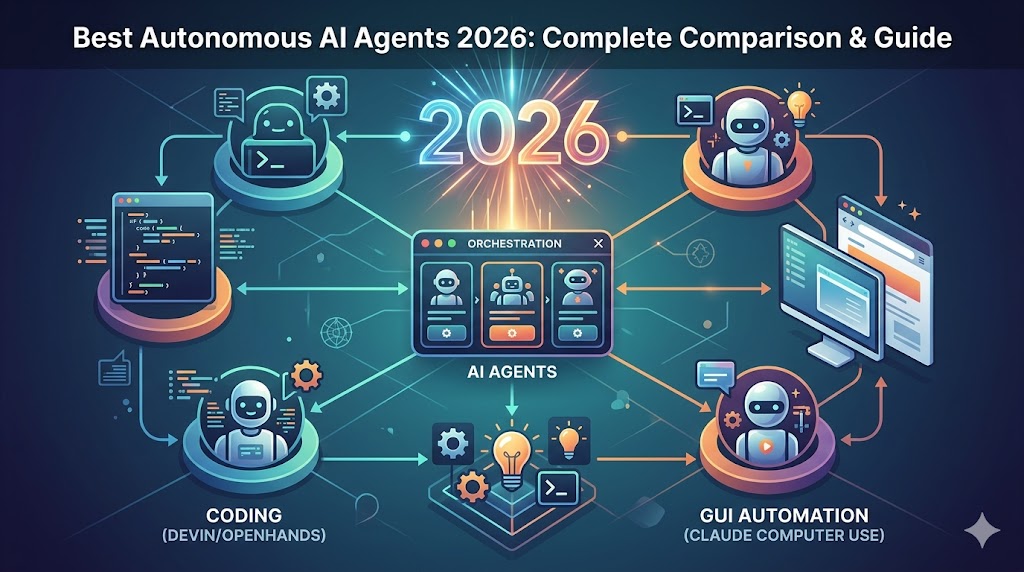
- The End of Monolithic Agents: Single monolithic agents (like early AutoGPT) are dead. 2026 is ruled by multi-agent orchestration (LangGraph, CrewAI) where specialized agents handle isolated sub-tasks.
- GUI Automation works: Anthropic's Claude Computer Use now reliably navigates web apps and legacy desktop software that lack APIs.
- Cost vs. Reliability: Running open-source agents (OpenHands) on local hardware with Llama 3 or Qwen3-Coder saves thousands in API costs but requires a steep setup curve.
Expert Insight: The biggest paradigm shift in 2026 isn't smarter base models—it's better agentic memory and tool-use reliability. Agents now natively understand when to read documentation, when to write tests, and when to ask the human for clarification to avoid infinite loops.
The Shift to Multi-Agent Architectures
In 2024, the goal was to build one agent to do everything. In 2026, the industry standard is Multi-Agent Orchestration. Instead of asking one LLM to act as a researcher, coder, and QA tester, frameworks like LangGraph and CrewAI allow developers to define specific personas. These personas debate each other, hand off state, and validate each other's work.
Top Autonomous Agents & Frameworks Compared
We evaluate agents across two categories: Out-of-the-box Products (SaaS) and Developer Frameworks (Code-first). Here is how the top players rank.
| Agent / Framework | Category | Best For | Learning Curve | Cost Model |
|---|---|---|---|---|
| Devin (Cognition AI) | Product | End-to-end software engineering | Low | Premium SaaS ($$$) |
| OpenHands (OpenDevin) | Product / CLI | Open-source coding autonomy | Medium | BYO-API or Local LLM |
| Claude Computer Use | API Capability | Legacy UI automation, QA testing | Medium | Pay-per-token API |
| LangGraph | Framework | Building custom enterprise agent loops | High | Open Source (Python/JS) |
| CrewAI | Framework | Role-based multi-agent teams | Medium | Open Source (Python) |
Coding Agents: Devin vs. OpenHands vs. SWE-agent
Software engineering is the ultimate stress test for autonomous agents because the feedback loop is absolute: the code either compiles and passes tests, or it doesn't.
Devin: The Polished Professional
Cognition AI's Devin remains the commercial leader. You drop a GitHub issue link into Devin's chat, and it spins up a secure cloud container, clones the repo, reads the documentation, writes the fix, runs the tests, and opens a Pull Request. Its proprietary agentic loop is incredibly resilient at recovering from compiler errors.
OpenHands & SWE-agent: The Open Source Kings
If you don't want to pay enterprise SaaS fees, OpenHands (formerly OpenDevin) and Princeton's SWE-agent are exceptional. OpenHands features a beautiful UI that runs locally via Docker. You can hook it up to Claude 3.5 Sonnet or run it 100% locally with DeepSeek Coder or Qwen3-Coder via Ollama.
memoryRunning OpenHands Locally?
Local coding agents demand serious hardware. To run Qwen3-Coder 32B or DeepSeek locally alongside OpenHands, you need a high-VRAM machine.
Find High-VRAM Laptops →Claude Computer Use: The GUI Revolution
Anthropic shifted the paradigm by giving Claude native Computer Use capabilities. Instead of relying purely on REST APIs, Claude can look at a screenshot, calculate the X/Y coordinates of a button, and move a virtual mouse to click it.
To use this, developers utilize the Anthropic API to pass screenshots and receive mouse/keyboard commands. Frameworks like Browser-Use have wrapped this capability into easy-to-use Python libraries.
Quick Example: Browser-Use Script
Here is how simple it is to build a web-browsing agent in 2026 using Python:
Performance & Cost Benchmarks
Agentic workflows consume significantly more tokens than simple chatbots because the agent must "think," execute a tool, observe the result, and iterate. A single task might trigger 15-20 LLM calls.
Cost Management Strategy: Modern setups use a "router" approach. A cheap, fast model (like Claude 3 Haiku or Gemini 1.5 Flash) handles basic routing and simple tool execution, while heavy-duty reasoning is routed to expensive models (Claude 3.5 Sonnet or GPT-4.5) only when the agent gets stuck.
Decision Tree: Which Agent Should You Choose?
If you're overwhelmed by options, follow this quick heuristic:
- If you have budget but no time: Pay for Devin. It is the most robust commercial agent for software engineering right out of the box.
- If you want full control and privacy: Run OpenHands locally with Ollama and an RTX GPU. It keeps your codebase entirely offline.
- If you need to automate non-API legacy apps: Build a script using Claude Computer Use to physically click and type through the UI.
- If you are building an enterprise workflow: Use LangGraph. It is the industry standard for creating deterministic, multi-agent systems.
Troubleshooting Common Agent Failures
The Infinite Loop Trap: The most common failure mode in 2026 is an agent getting stuck trying to fix the same compiler error repeatedly.
If your autonomous agent fails, check these three things first:
- Context Window Degradation: Even if a model supports 200k tokens, an agent will lose track of the core objective if it reads too many large files. Fix: Explicitly prompt the agent to write a summary of its current state to a scratchpad file before continuing.
- Environment Mismatches: The agent writes code for Node v20 but runs it in a container with Node v16. Fix: Always provide the agent with a strict `Dockerfile` or environment specification upfront.
- Vague Acceptance Criteria: Agents are literal. If you tell an agent to "build a login page," it won't know when to stop polishing the CSS. Fix: Provide rigid pass/fail criteria (e.g., "Stop when the login form successfully authenticates against the mocked API and redirects to /dashboard").